Elly Novick

Media Culture and Practice
April 27, 2015
Final Project Proposal
Portraying the disruption of the everyday through the use of photography has proven to convey its meaning discreetly so that what it depicts isn’t obvious, making the image more interesting for the viewer to study. For our project, we propose to create a panoramic image of the Harbourside, displaying the daytime (on the left) and the night time (on the right). In the middle of the two images we will hope to create some form of transition to blend the two large images together, or a slight blur. This image will be the home screen of our website which you can then click on a button which takes you more enlarged images of the scenarios and people in the night time acting as though they are in the day time, and vice versa. We intend to display the differences between the day and night but in the same place and how the atmosphere can be totally different in the day compared to the night and also how peoples’ behaviours can change, also trying to link the characters to modern expectations of behaviour.
April 24, 2015
Editing in lights within the night

Final pano
We struggled with editing the night time side of the panorama as we couldn’t seem to figure why it didn’t look realistic. However, today we found the answer. By editing in lights which would be on at night it brought the image to life and made the night time scene alive.
We used Photoshop to edit the light elements into the scene using a number of tools. This involved using the magnetic lasso tool to select the section. From then we filled the section with a feather effect with a low opacity, giving the colours a soft subtle effect.

Refining the edges to soften them

Adjusting the brightness levels

Adding colours to the lights to bring them to life
April 24, 2015
Hyperlinks within the website
When toying with ideas of incorporating the impact our disruption of social norms and the causes it has within the everyday, we thought that it may be an interesting idea to bring together public discussions around the characters we edited. Such as, scientific discussions over when its best to study in the time of day; day or night? Also, what bouncers really think when refusing people into clubs. When is it classed as too old to drink according to societies view? These hyperlinks explore the questionings behind the disruptions created in our project.

Figure 2

Figure 1

Figure 3

Figure 4
April 24, 2015
Designing our website and the use of social media
When brainstorming idea for the design for our website we wanted to explore ways in which we could capture the disturbance in the everyday our concept created. Social media seemed like a good way to illustrate the impact and make it present in our modern society. By having the reactions voiced in social media outlooks it shows the way the disturbance of peoples ‘fronts’ and ‘performances’ (which Goffman identifies) it shows the way other peoples everyday have been disturbed.

Figure 1- Instagram layout design
Visually, we wanted to create a montage style of a group of different social media styles to show the range and distance the disturbance caused. By looking at existing designs such of social media, such as Instagram, it inspired us to design the background of the website in a montage style to in a way overwhelm the viewer, showing the power of disturbance. (Figure 1)
Media sources ‘provide unique windows into people’s thoughts and personal lives. They represent, as Tucker et al. (2006: 18) put it, ‘culture makers with their guard down.’ (Good, 2013)
This quote shows how social media creates margins which we constrain our perceptions of social norms.

Figure 2- montage of social media reactions of disturbance
April 24, 2015
Editing in the disturbance of social norms
As our concept was based upon the disturbance of social norms and preferences which we consider as normal in our everyday, being able to distort and edit these changes was essential. To do this we shot separate scenes and characters which we later editing in onto the harbour sense.

Figure 1- editing using lasso tool
To edit the characters in we used the lasso and polygon lasso tool to extract them from their original photo and pasted them onto the main pano scene. By using the lasso tool it allowed us to specify small details and carefully cut around the features.
This left us with figure 2 which we then placed onto the main pano.
Once cut with the lasso tool some of the images, such as the old woman, had to be softened around the edges, to create a more subtly and less edited effect. (Figure 3)

Figure 3

Figure 2 – edited

Figure 4- implanting characters onto scene
April 23, 2015
Editing techniques for manipulating the night light levels
As our project is based upon the distortion of our perceptions and social norms , being able to technically manipulate images was essential. We wanted to explore the way in which time can be used to distort behaviours and characters within the everyday. To be able to capture this concept fully we experimented with Photoshop and its tools.
We first conducted a test shoot, to see the best way to carry out the panorama. We did this by renting out a camera and tripod and experimented with angles and distances to visually see how we could create our project. Below is the test shoot which we stitched in Photoshop to give the panorama effect.

We found that by looking at Youtube tutorials it helped clarify and explain how we could achieve the level of distortion we hoped for. Below is one of the links we used to distort the light of day.
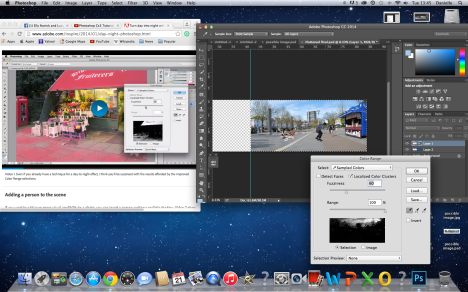
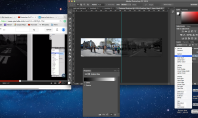

We did come into a few technical issues when editing the night time image. Such as finding the perfect levels which differed between with the object and positioning in the frame. Through playing with the various techniques such as the dodge tool, which was used to lighten the people and adjusting the saturation and brightness down it enabled us to edit the designated scene into a night time effect.
April 14, 2015
Goffman and our fronts in the everyday
Goffman’s piece on ‘The Presentation of Self in Everyday Life’ is an interesting argument to explore in the context of my project, on his ideas on society being seen as a performance, which people project onto each other to form a sense of identity (known as a ‘front’).
In my project I want to explore the disturbance of social norms within our everyday and from reading Goffman’s piece I think it’s a great way for me to explore and identify how characters in the urban sphere and the performance they conduct occurring to their character in society. “Engaging in formal social activity, work or informal recreation” (Goffman) For example, a bouncer standing at the front of a bar appears and behaves in an authoritative front, but positioning him out of his work environment changes the way in which we would see and feel about him (less superior).
Goffman identities the subject of a “setting” to refer to the scenic parts of expressive equipment, one may take a “personal front” to refer to the other items of expressive equipment, the items hat we most intimately identify with the performer himself'(Goffman). So, in my project by manipulating the setting and time frame, this distorts the setting of peoples ‘personal fronts’, therefore manipulating their identity.
April 1, 2015
Global Activism Within the Online Community
http://www.bbc.co.uk/iplayer/episode/b052n6bh/sign/an-idiots-guide-to-politics
I am currently researching information regarding my essay on: ‘How do digital technologies allow new forms of intervention and/or dialogic agency in the public sphere?’ I came across a BBC documentary, called ‘An Idiots Guide to Politics’. It explores why in this new age of online viral expression, the younger generation would rather vote for artificial game shows, such as X Factor, but will not cast a vote in the general election. The documentary asks the question: does it really matter who we vote for? As the big money will always win.
I personally have experienced this from the 2010 elections where the coalition struck students; charging up to £9000, whereas originally their selling policy was to free education. I was involved in a peaceful student protest at the age of 15 where I actually ‘felt’ that my presence, and the many others that accompanied me, was making an impact and a political statement.
The BBC documentary looked at online activism groups, such as ‘Autonomous’, ‘a collective of hackers, who say their goal is to corrupt governments to account. They are part of an online activists, challenging the status-quo.’ (BBC) The show covered a demonstration in Trafalgar Square on the 5th of November. Listening to individuals in the crowd voice their opinions was interesting to see in the context of research for my essay as one person said: ‘Politics isn’t just in that building. Politics isn’t just on a ballet paper. Politics is making your voice heard like today’. This is the exact point I want to explore in my essay. The power the internet has in giving people a voice and making those words heard. The vast decrease in election votes isn’t necessarily due to the fact that people don’t care but it could also be due to the fact that people are finding their own outlets to voice their votes. It’s an interesting concept to explore, as even though I personally agree that my vote won’t truly make a strong difference, it still needs to made to conform to the ‘official’ government system.
March 26, 2015
Feminism within a culture based on appearance
This video, which was publish on my Facebook newsfeed by Tattoo Spirit, brought together the debate of gender roles within society, and what characters determine a person to be classified as either male or female. The caption of the video on Youtube writes:
‘A short film about gender roles, Trans, and what it is like to have an identity that deviates from the status quo.’ (Youtube, Ruby Rose, July 2014)

